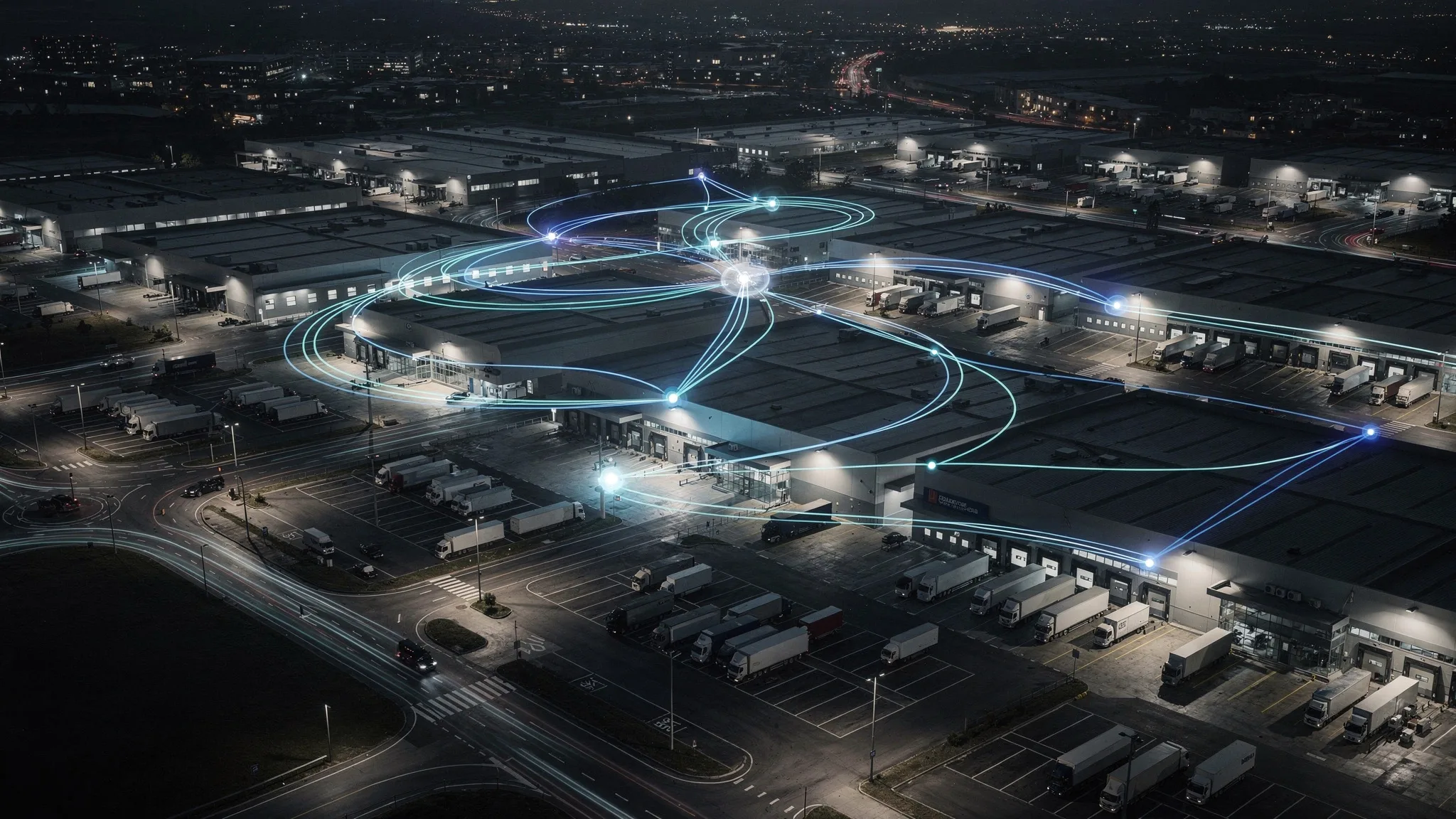
How TruckFlow Logistics Cut Route Planning Time by 40% with AI Dispatch
TruckFlow Logistics deployed an AI dispatch system that cut route planning time by 40% and reduced fuel spend by 23% within 90 days.
The Problem: Manual Dispatch Was a Full-Time Job
TruckFlow Logistics operated a regional fleet of 47 vehicles across three distribution hubs. Each morning, four dispatchers spent between three and four hours building the day’s routes manually — cross-referencing delivery windows, vehicle capacity, driver hours, and road conditions from separate spreadsheets.
Errors were frequent. A missed delivery window could trigger penalty clauses. A suboptimal route burned fuel that erased the margin on the delivery. And as the fleet grew, the problem compounded: adding vehicles added dispatcher hours linearly, making scale economically painful.
The company’s operations director framed the challenge simply: “We were paying experienced people to do work that a computer should do.”
The Solution: AI-Powered Route Optimisation
TruckFlow evaluated three route optimisation platforms over six weeks before selecting one built on a constraint-satisfaction ML model that ingested live traffic data, historical delivery performance, and vehicle telematics.
The implementation had three phases:
Phase 1 — Data Integration (Weeks 1–3)
Connected the platform to the existing TMS (Transport Management System) via API. Historical delivery data from 18 months was imported to train the model on TruckFlow’s specific delivery patterns, customer time windows, and driver performance profiles.
Phase 2 — Parallel Running (Weeks 4–6)
Dispatchers continued building routes manually while the AI generated alternative routes in parallel. Dispatchers reviewed both, flagging disagreements. This data was fed back into the model.
Phase 3 — Live Deployment (Week 7+)
The AI generated the opening route plan each morning. Dispatchers reviewed and approved with minor adjustments rather than building from scratch. Average review time: 22 minutes, down from 3.5 hours.
Results at 90 Days
The outcomes exceeded projections across every tracked metric:
- Route planning time: reduced from 3.5 hours to 22 minutes per dispatcher per day
- Fleet-wide route efficiency: improved by 40% measured by deliveries completed per vehicle-hour
- Fuel spend: down 23% against the prior 90-day period
- On-time delivery rate: improved from 84% to 96%
- Dispatcher capacity: the same four dispatchers now manage a fleet 30% larger than at implementation
The Adoption Challenge
The technology worked immediately. The people took longer.
Three of four dispatchers initially resisted the system. Their objection was not performance but professional identity — they had spent years developing route-building expertise, and they perceived the AI as a replacement rather than a tool.
TruckFlow’s operations director addressed this directly: “We reframed their role. They became route quality controllers, not route builders. The AI was their assistant, not their replacement.”
Within 60 days, all four dispatchers reported positive sentiment toward the system. Two became internal advocates, training drivers on the new digital manifest system that accompanied the rollout.
What Made This Work
Three factors separated TruckFlow’s success from failed AI logistics deployments:
Clean historical data. The model required good data to learn TruckFlow’s patterns. Companies without clean TMS data spend months in remediation before AI can deliver value.
The parallel running phase. Skipping directly to AI-only routing is a common mistake. The parallel phase built both model accuracy and dispatcher trust simultaneously.
Reframing roles before deployment. Announcing the change as “AI will handle routing” creates resistance. Framing it as “you’re becoming route quality managers” creates ownership.
Replicability
This approach works for any fleet operation with at least 15 vehicles and 12 months of delivery history. The technology cost has dropped significantly — platforms that required enterprise contracts in 2022 now offer SMB pricing that pays back within a quarter at TruckFlow’s scale.
The core principle generalises beyond logistics: find the process where your most experienced people spend the most time on pattern-matching work, and make the AI do the pattern-matching.
This case study is an illustrative composite based on typical engagement patterns in this industry. Company names and figures are anonymized examples, not a specific named client.