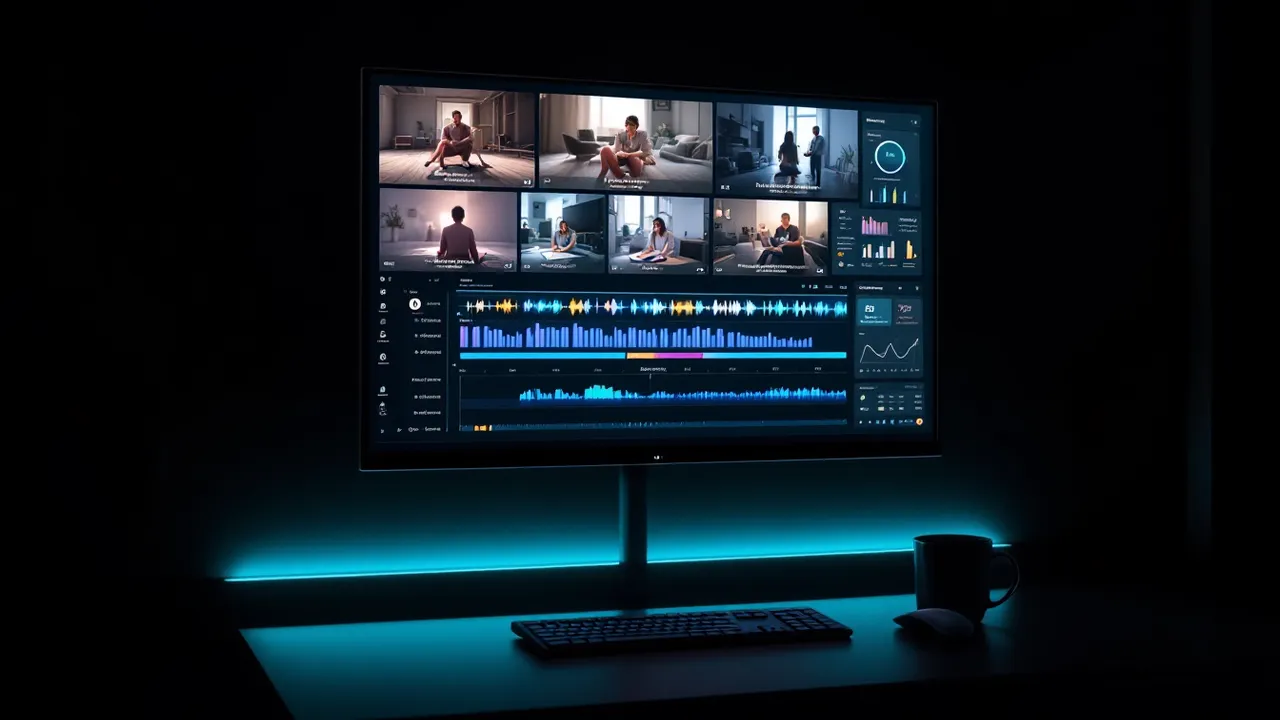
AI Video Repurposing: Turn One Long Video into a Month of Short-Form Content
How AI clipping tools turn webinars, podcasts, and demos into short vertical clips — the workflow, the metrics that matter, and realistic expectations.
The Cheapest Content You Are Not Publishing
Most businesses that record anything — webinars, podcast episodes, product demos, conference talks — are sitting on their most underused marketing asset. A one-hour recording typically contains ten to twenty self-contained moments: a sharp answer, a counterintuitive claim, a before-and-after demo. Each of those moments is a potential short vertical video for TikTok, Instagram Reels, or YouTube Shorts.
Short-form video is where discovery happens now. Wyzowl’s annual video marketing survey has tracked video’s steady climb for a decade: the overwhelming majority of marketers report video drives traffic and leads, and short-form consistently delivers the highest ROI of any video format. Yet most companies publish little of it, because the traditional path — brief an editor, wait days, pay per clip — makes each video expensive enough that nobody experiments.
That economic constraint is what AI clipping removes. This article covers what the tools actually do, a workflow that fits into a normal marketing week, and how to judge results once clips are live.
What AI Clipping Actually Does
The pipeline behind every serious tool in this category looks roughly the same:
-
Transcription. The audio is converted to a time-coded transcript. Accuracy matters more than it sounds — every later step depends on it.
-
Moment detection. A language model scans the transcript for segments that work standalone: a complete thought, a hook-worthy opening line, an emotional peak. Better tools score each candidate clip for its likely performance.
-
Reframing. The 16:9 source is cropped to 9:16 vertical, with the active speaker tracked so faces stay in frame — the step that used to consume most of a human editor’s time.
-
Captions and cleanup. Word-by-word subtitles are burned in (a large share of short-form viewing happens on mute), silences and filler words are trimmed, and hooks or B-roll can be added.
The output is a batch of ten or more publishable clips from one source video, produced in minutes rather than days. Quality is not uniform — expect a third of the clips to be genuinely good, a third usable after a small manual trim, and a third discardable. That ratio is still transformative compared with hand-editing.
A Workflow That Fits a Normal Week
The teams that make this work treat it as a repeatable pipeline, not an occasional stunt:
-
Record long-form once a week. A customer webinar, an internal AMA, a founder interview — anything with substance. You need one hour of source material weekly.
-
Run it through an AI clipper the same day. Review the scored candidates, keep the best five to eight, fix any caption errors (product names and jargon are the usual casualties).
-
Schedule the batch across platforms. Spread clips over the following two weeks rather than dumping them in one day. Most tools include a scheduler; a spreadsheet works too.
-
Review metrics weekly and feed the findings back. Which topics, hooks, and lengths performed? That intelligence shapes what you record next week.
Total marketing time: roughly two to three hours per week for ten or more published videos — less time than most teams spend producing a single edited clip manually.
The Metrics That Actually Matter
View counts are the least informative number in your analytics. Short-form platforms show each new clip to a small test audience and expand distribution only if that audience responds, so the numbers to watch are the ones the algorithm watches:
-
Hook rate — the share of viewers still watching at second three. If fewer than half survive the opening, the problem is the first line and first frame, not the topic. Clips cut from long-form often fail here because they open with wind-up rather than payoff; move the sharpest sentence to the front.
-
Retention curve shape — a sharp early drop means a broken hook; a steady slide means slow pacing (cut pauses harder); a cliff mid-video means the clip stopped delivering what the hook promised.
-
Completion rate — viewers who watch to the end, the strongest single signal for further distribution. Shorter clips complete more often; most 60-second clips are better as 25-second clips.
-
Follows per thousand views — whether clips convert strangers into audience. If reach grows but follows do not, the clip works and the profile does not.
Judge formats on a series of clips over a week, not on any single video’s first hours — early numbers reflect posting time more than content quality.
Choosing a Tool
The market has matured into a few reliable options. OpusClip is the best-known English-language clipper; Descript suits teams that want text-based editing of the source video as well. For Russian-language content, MnogoReels is the strongest option we have tested — its speech recognition and caption quality on Russian audio noticeably outperform the English-first tools, and it bundles clip scoring, auto-captions, and a cross-platform scheduler (including VK Clips, which Western tools ignore) in one workflow.
Whichever tool you choose, run the same evaluation: feed it one of your real recordings, count how many of the generated clips you would actually publish, and check caption accuracy on your industry’s vocabulary. Free tiers exist across the category precisely so you can run this test before paying.
Realistic Expectations
AI clipping compresses production, not strategy. Three caveats from teams that have run this for months:
-
Source quality caps output quality. A meandering webinar yields meandering clips. Recordings made with repurposing in mind — concise answers, strong statements, minimal rambling — clip dramatically better.
-
The first weeks are calibration. Expect modest numbers while you learn which topics and hooks your audience responds to. The pipeline’s value is that iteration is cheap enough to actually do.
-
A human still reviews everything. Caption errors on product names, clips that cut a thought in half, moments that read differently out of context — five minutes of review per clip prevents the failures that erode trust.
The companies winning short-form right now are rarely the ones with the biggest production budgets. They are the ones that made publishing cheap enough to learn faster than their competitors. If you already record long-form content, the raw material is sitting in your archive — the only question is whether it keeps sitting there.